The path through heart and time: memoirs of Mykola Amosov
Surgeon, thinker, reformer — in the midst of change and personal discovery
In July 1982, Amosov experienced a crisis — many patient deaths. He decided to give up surgery for the summer and focus only on cybernetics. He lived at his dacha and worked on models of society. Only in November did he return to surgery.
In 1983, the clinic was spun off into the Institute of Cardiovascular Surgery. After a visit to the Central Committee and Shcherbytskyi, Amosov was appointed director. The plan was to perform 4000 operations a year, 2000 with a heart-lung machine. In December, he celebrated his 70th birthday. Perestroika began: freedom of speech, less fear of the KGB.
In 1985, heart problems began. A stimulator was installed in Kaunas. In 1986, I started working again. We survived Chernobyl at the dacha. I thought the panic was exaggerated. In 1987, they introduced economic calculation — more operations, higher salary.
In 1988, on his 75th birthday, he resigned as director, but continued to operate. In 1989, he was elected People’s Deputy of the USSR. At first, he believed in change, but realised that he had no real power. Attempts to help medicine failed, and people lost trust.
At 70, he was the director of an institute, at 75, a deputy, and at 80, a marathon runner. From surgery to philosophy — Amosov did not stop even when his heart stopped
He resigned from the parliament for medical reasons. But he used his time in Moscow for research and changed his views: he recognised the superiority of capitalism over socialism.
In 1991-1992, the USSR collapsed and Ukraine declared its independence. His hopes were not fulfilled: poverty, corruption, economic decline. In 1992, he wrote an article entitled “My Worldview” and continued to publish philosophical articles. He finally left surgery after the death of a patient.
In 1993, he had his stimulator replaced and celebrated his 80th birthday. He decided to fight old age: three times a day, 3000 exercises, 5 km of running. It worked, but later his heart condition deteriorated.
In 1997, he conducted a large sociological survey, which revealed a split in public opinion. In 1998, his health deteriorated further. He wrote his memoirs Voices of the Times. In May, he went to Germany for an operation to have a valve implanted and bypass surgery. Everything was successful, but rehabilitation lasted several months.
The last experiment
off the table, and the method turned on himself
The operation in Germany bought him four more years. He came back to Kyiv with an implanted valve and grafted bypasses, at eighty-four — a patient of the same operation he had spent his life performing on other people. Recovery took months.
Then he went back to the experiment. He had been running it on himself since his eightieth year: three thousand movements a day, five kilometres of running, the weight held down, on the argument that in old age the load should not be reduced but raised. After the surgery he restarted at a lower dose and worked it back up, publishing what he measured — including the stretches where it stopped working.
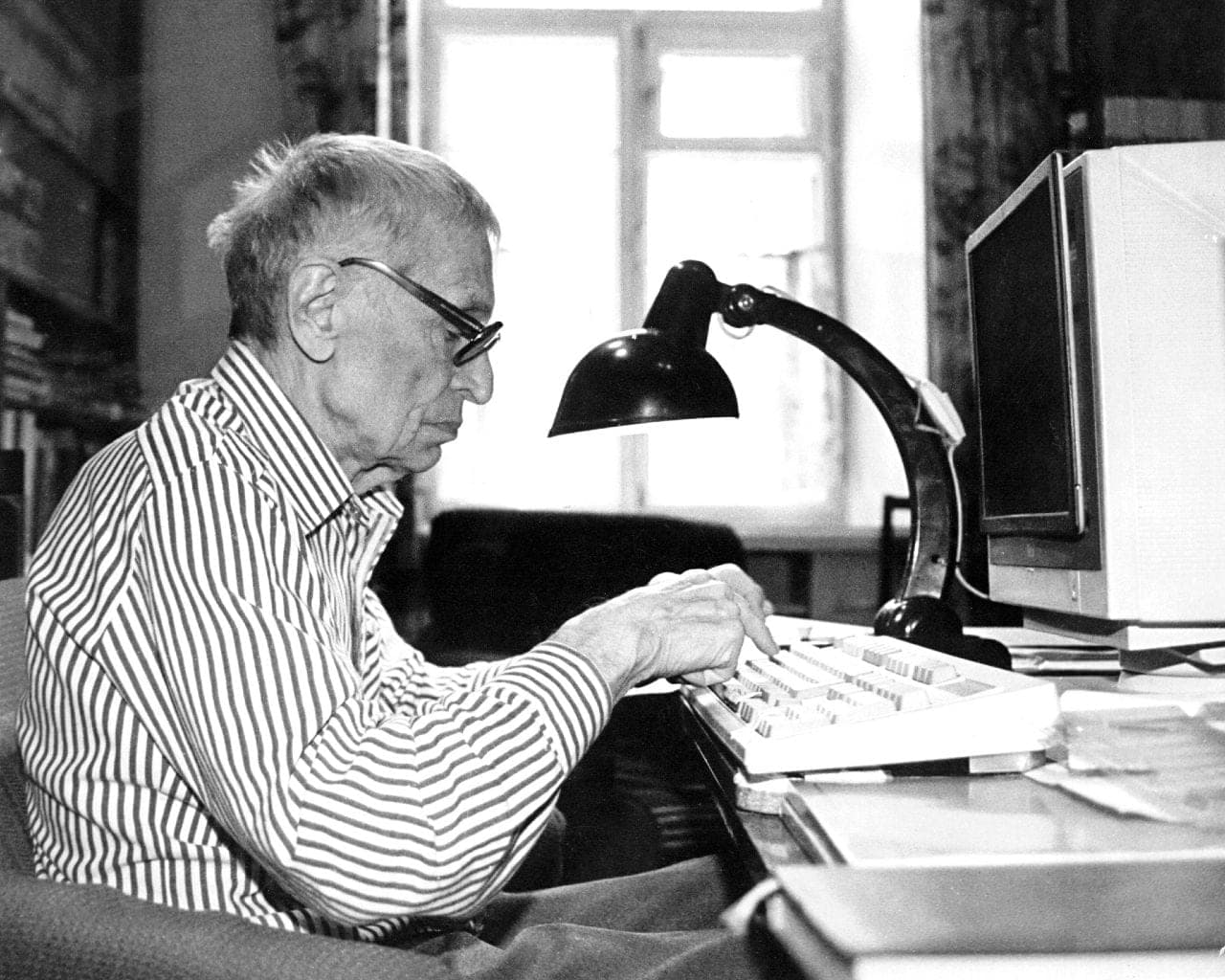
He wrote to the end. “My Worldview” in 1992, the large sociological surveys of the mid-nineties, the memoirs in 1998, philosophical articles after that — written at the computer, once walking had become difficult.
Do not count on medicine. It treats illnesses well enough, but it cannot make a person healthy — that takes your own effort, constant and considerable
The sentence is his, and he repeated it for forty years to anyone who would listen. It is the reason a cardiac surgeon with more than six thousand heart operations behind him is remembered by millions of people who never went near an operating table.
Mykola Amosov died on 12 December 2002 in Kyiv, of a heart attack, six days after his eighty-ninth birthday. He is buried at Baikove cemetery.
In March 2003 the institute he had founded was given his name. In 2008, when a television project asked the country to name the greatest Ukrainian in its history, he finished second out of fourteen thousand names put forward — the only doctor anywhere near the top of the list.